

Healthcare for High-Deductible Plans
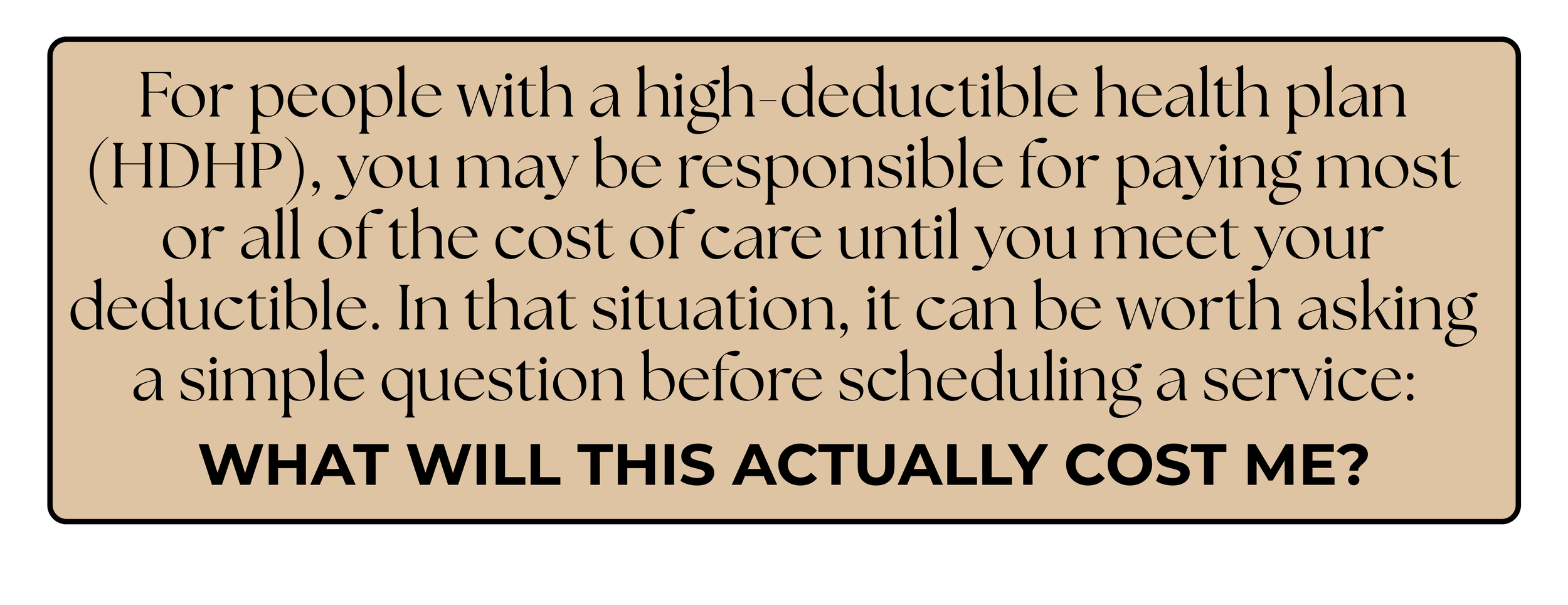
Have insurance but still paying for most of your healthcare? If you have a $5,000, $7,000, or $10,000 deductible, you are paying cash for many routine medical visits anyway.
Rooted Health offers another option: transparent cash pricing so you know what your care costs before you book.
Want a copy of our free healthcare spending guide for high-deductible healthcare plans?
Everyday, patients save THOUSANDS of dollars by searching out cash-based care instead of utilizing their HDHP for provider visits, labs, and imaging.
Let’s Look At A REAL WORLD Example:
A patient needed an MRI
Patient cost Using insurance - $1,500
Paying the cash price - $550
Potential savings - $950
In this example, using insurance would have cost nearly three times as much as paying cash.
But doesn't using insurance help me meet my deductible?
Sometimes, yes—and that is an important part of the decision.
If the patient pays $1,500 through insurance, that amount may count toward their deductible and future covered healthcare expenses, depending on the plan and how the claim is processed. CMS explains that people with a deductible may be responsible for the allowed amount of covered services until the deductible is met.
But if you are unlikely to meet your deductible during the year, paying significantly more simply to receive deductible credit may not always make financial sense.
In this example, consider the difference
Option 1: Use insurance
You pay: $1,500
Amount potentially applied toward your deductible: $1,500
Option 2: Pay cash
You pay: $550
Immediate savings: $950
The question becomes:
Is paying an extra $950 today worth receiving $1,500 of deductible credit that you may or may not use before the end of your plan year?
For some people, the answer may be yes. For others—especially those who are generally healthy and don't expect significant additional medical expenses—it may be no.
The hidden advantage of shopping for healthcare
Healthcare prices can vary dramatically.
Before assuming that using insurance will give you the lowest price, consider asking:
What is my insurance responsibility for this service?
Have I met my deductible?
What is the self-pay or cash price?
Is there a discounted price if I pay at the time of service?
Can I submit documentation to my insurance plan afterward?
Will this expense count toward my deductible or out-of-pocket maximum?
If you choose not to use insurance and self-pay, you can generally request a written Good Faith Estimate of expected charges for scheduled care. CMS specifically recognizes that some people choose not to use insurance because paying out of pocket may be less expensive.
Cash-Based Care Gives You Another Option
Cash-based care isn't about avoiding insurance altogether.
It's about becoming an informed healthcare consumer and comparing your options.
For routine visits, labs, imaging, medications, and other planned healthcare expenses, the price you pay using insurance may not always be the lowest available price.
Before assuming insurance is the best deal, ask for the cash price. Compare your options. Then choose what makes the most financial sense for you.
Important: Every insurance plan is different. Cash payments may not count toward your deductible or out-of-pocket maximum, and submitting a superbill does not guarantee reimbursement. Always check with your insurance plan before making a decision.